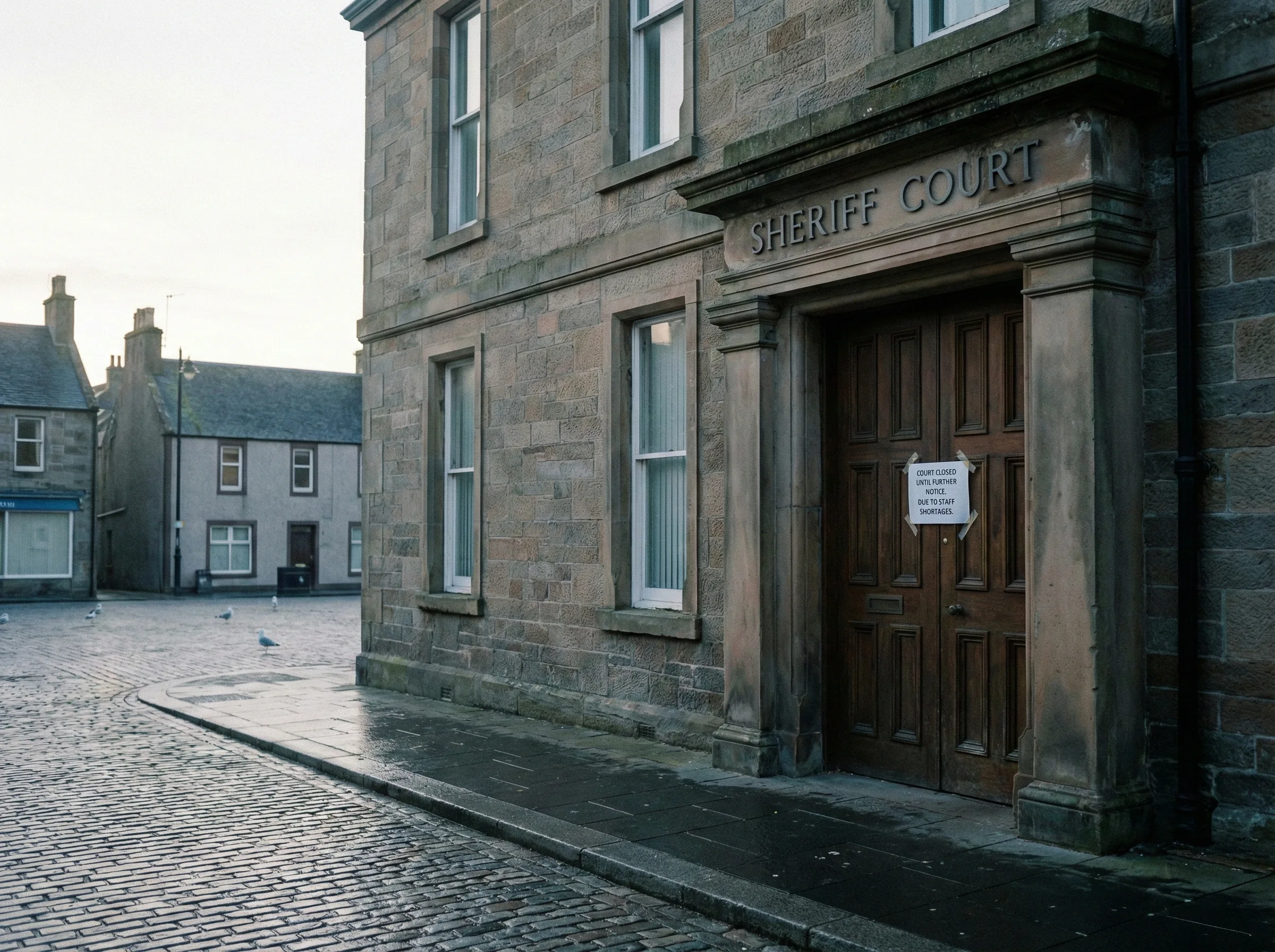
Scottish courts do not use one shared closure calendar. The revised 2026 SCTS calendar lists 28 courts and offices. If a calculation depends on a court closure, select the particular court or office rather than Scotland generally.
This guide uses the revised SCTS Public & Privilege Holidays 2026 v2 PDF, checked on 3 September 2026.
Are Scottish courts open on bank holidays?
Some Scottish courts close on particular bank holidays, but there is no single Scotland-wide court closure calendar. SCTS publishes different public and privilege holiday dates for individual courts, tribunals and offices.
A date appearing on a general Scottish bank-holiday list does not by itself confirm that a particular court is closed. A court may also observe a local or privilege holiday that is not on the general list. Check the SCTS calendar and the page for the relevant location before attending court or calculating a deadline affected by an office closure.
Eight closure dates are shared by every location
All 28 courts and offices share these eight dates:
| Date | Day | Published occasion |
|---|---|---|
| 1 January 2026 | Thursday | New Year closure |
| 2 January 2026 | Friday | New Year closure |
| 3 April 2026 | Friday | Good Friday |
| 6 April 2026 | Monday | Easter Monday |
| 4 May 2026 | Monday | May holiday |
| 30 November 2026 | Monday | St Andrew's Day |
| 25 December 2026 | Friday | Christmas Day |
| 28 December 2026 | Monday | Boxing Day substitute closure |
These are the only dates common to every location. Each court or office also has its own spring, summer, autumn or Christmas closures.
Local closures can change the result
The following examples show why the selected location matters:
| Court or office | Additional 2026 closures in the revised PDF |
|---|---|
| Aberdeen Sheriff Court, JP Court & High Court | 13 July, 3 August, 21 September |
| Airdrie Sheriff Court | 25 May, 20 July, 28 September |
| Edinburgh Sheriff Court & JP Court | 20 April, 18 May, 6 July, 21 September |
| Court of Session / Judicial Office | 20 April, 18 May, 21 September, 24 December |
| Kirkwall Sheriff Court | 8 June, 3 August, 28 September |
Edinburgh Sheriff Court closes on 6 July, but the Judicial Office does not. The Judicial Office closes on 24 December, but Edinburgh Sheriff Court does not. The two calendars therefore produce different results for some periods.
A general Scottish bank-holiday list is not a substitute for an SCTS calendar. For example, every location in the SCTS table closes on Easter Monday, although GOV.UK does not list Easter Monday as a Scotland-wide bank holiday.
The SCTS public-holidays page and the individual location pages carry each court's full list. The Edinburgh Sheriff Court page, for instance, lists its 2026 holidays one by one.
The revised v2 calendar matters
SCTS replaced its original 2026 PDF with version 2, which made three changes:
- 6 July was added for Edinburgh, Jedburgh, Livingston and Selkirk Sheriff Courts;
- the half-day asterisks were removed, having previously appeared for Headquarters on 11 September, Tribunals Operations Glasgow on 25 September, and the Judicial Office, Office of the Public Guardian and Supreme Courts Glasgow on 24 December; and
- a note was added about a floating public holiday for employees of most Sheriff Courts.
The calculator's 2026 SCTS data was regenerated from v2. The dates that had an asterisk in the original file are now full closures, and the four new 6 July closures are included. A result from the old calendar can differ from one calculated today, so record the source version with any result you need to refer back to.
The floating holiday has no date in the PDF and no common closure day across the affected courts. Ask the court about any local arrangement before relying on the calculation; no floating-holiday date is included.
Version 2 has no starred dates. Where a starred half-day closure does appear in an SCTS calendar, the calculator counts that date as a working day, because the court is open for part of it. Check the office hours if the deadline falls on one.
This annual calendar does not show every operational restriction. Edinburgh Sheriff Court publishes monthly afternoon closures for parts of its office. Those are office hours, not whole-court holidays.
Worked example: Edinburgh and the Judicial Office
Assume a procedure gives six calendar days after 30 June 2026, includes the resulting day, and moves an act due on a closed court day to the next open day. The sixth day is Monday 6 July 2026 before the court calendar is applied.
| Court or office | 6 July status | Result |
|---|---|---|
| Edinburgh Sheriff Court & JP Court | Published closure | Tuesday 7 July 2026 |
| Court of Session / Judicial Office | Open | Monday 6 July 2026 |
| Setting | Selection |
|---|---|
| Mode | Court rules |
| Jurisdiction | Scotland |
| SCTS Court Calendar | Edinburgh Sheriff Court & Justice of the Peace Court |
| Workflow | Filing |
| Trigger date | 30 June 2026 |
| Number of days | 6 |
Open the Edinburgh court-calendar example in the calculator.
For Edinburgh, the calculator shows 6 July as the calculated date, identifies the SCTS closure, and gives 7 July as the filing date. For the Judicial Office, 6 July remains the result. Both results follow from the selected calendar. You still need to establish which court and procedural rule govern the case.
What the calendar cannot answer
The PDF tells you when a court is closed. It does not set the length of a period or its starting point. Check the procedural rule for the length of the period, how it is counted, the trigger, service or intimation date, and whether a closure moves a deadline or only affects the office's availability.
SCTS maintains separate collections for Court of Session rules and Sheriff Court civil procedure rules. Filing cutoffs, partial office hours and urgent arrangements come from SCTS directly rather than from the annual holiday list.
Sources
- SCTS public and privilege holidays — the official annual source page, including the warning that locations operate varying closures; checked 3 September 2026
- SCTS Public & Privilege Holidays 2026 v2, the current location-by-location calendar used here
- Edinburgh Sheriff Court & JP Court, location-specific holiday and office information
- SCTS rules of court for the applicable procedural rules