Calendar background

Working Days Calculator

FOR THE UNITED KINGDOM

TAKING THE UNCERTAINTY OUT OF LEGAL DEADLINES

Start Calculating

UK Working Day Rules & Bank Holiday Guide

Technical reference for UK working-day rules, CPR clear days, SCTS court closures, and jurisdictional bank holidays. For real-world scenarios, visit Use Cases. For deep-dives and edge cases, browse Articles.

Start with CPR 2.8 clear days, Scottish court holidays, notice to complete, or the UK bank holiday breakdown.

How notice, deadline, and CPR rules are counted

  • Notice (backward): Service deadline is excluded; hearing/event date is excluded for clear days.
  • Deadline/filing (forward): Service/action date is excluded; deadline/filing date is included.
  • CPR clear-day rules keep both ends excluded in notice workflows; filing keeps the deadline included. The calculator shows these flags in timelines and exports.

Public Holidays

UK Bank Holidays

Last reviewed: January 2026

At-a-Glance

  • England & Wales: 8 bank holidays per year
  • Scotland: 9 bank holidays (includes 2 January and St Andrew's Day; no Easter Monday)
  • Northern Ireland: 10 bank holidays (includes St Patrick's Day and Battle of the Boyne)
  • Substitute days apply when bank holidays fall on weekends
  • King's official birthday may vary by jurisdiction
UK bank holiday celebration

What Are Bank Holidays?

Bank holidays are public holidays in the United Kingdom when banks and most businesses close. The term dates back to the Bank Holidays Act 1871, which first designated certain days for banks to close. Today, bank holidays are governed by the Banking and Financial Dealings Act 1971.

Jurisdictional Variations

The UK has different bank holiday arrangements for each jurisdiction:

  • England & Wales: 8 bank holidays including New Year's Day, Good Friday, Easter Monday, Early May bank holiday, Spring bank holiday, Summer bank holiday, Christmas Day, and Boxing Day.
  • Scotland: 9 bank holidays. Scotland observes 2 January and St Andrew's Day (30 November) but does not observe Easter Monday, which is a bank holiday in England & Wales.
  • Northern Ireland: 10 bank holidays, including all England & Wales holidays plus St Patrick's Day (17 March) and the Battle of the Boyne (12 July).

Substitute Day Rules

When a bank holiday falls on a weekend, the following Monday (or Tuesday if Monday is already a bank holiday) becomes a substitute bank holiday. This ensures that everyone benefits from the day off, regardless of their normal working pattern.

Examples:

  • Christmas Day on Saturday → Substitute bank holiday on Monday
  • Boxing Day on Sunday → Substitute bank holiday on Monday
  • Christmas Day on Sunday + Boxing Day on Monday → Substitute bank holiday on Tuesday

The calculator handles these substitutions automatically based on the year and jurisdiction you select.

One-Off Bank Holidays

Occasionally, the government proclaims additional one-off bank holidays for special occasions, such as royal jubilees, coronations, or state funerals. These are announced in advance and the calculator will include them in the relevant years.

Calculator Tip

The Working Day Calculator automatically excludes bank holidays when counting working days. Simply select your jurisdiction (England & Wales, Scotland, or Northern Ireland) and enter your date range. The calculator will handle all substitutions and jurisdictional variations for you.

Frequently Asked Questions

When a bank holiday falls on a Saturday or Sunday, a substitute bank holiday is observed on the next available weekday (usually Monday or Tuesday). This ensures that workers get their full entitlement of days off. The calculator automatically applies these substitution rules.

No. While England and Wales share 8 bank holidays, Scotland has 9 (including 2 January) and Northern Ireland has 10 (including St Patrick's Day on 17 March and the Battle of the Boyne on 12 July). Use the jurisdiction selector in the calculator to apply the correct holidays for your location.

There is no automatic legal right to time off on bank holidays in the UK. Your entitlement depends on your employment contract. However, full-time employees are entitled to at least 5.6 weeks (28 days) of paid annual leave per year, which may include bank holidays at the employer's discretion.

Yes, your employer can require you to work on a bank holiday if your contract permits it. There is no legal requirement for extra pay or time off in lieu for working bank holidays, although many employers offer enhanced rates or alternative days off as part of their employment terms.

Scottish Legal

Scottish Court Holidays & SCTS Closures (2026)

Last reviewed: January 2026

At-a-Glance

  • 2026 SCTS calendar now available with 46 court locations
  • Privilege days vary by court: 11–12 total closure dates per location
  • All courts closed: 1, 2 Jan; 3, 6 Apr; 4 May; 25, 28 Dec
  • Half-day closures on specific dates (e.g., 24 Dec at Supreme Courts)
  • Court-specific closures affect deadline calculations—use your exact court schedule
Scottish court building with closure schedule

Why SCTS Closures Matter for Deadline Calculations

The Scottish Courts & Tribunals Service (SCTS) publishes annual closure calendars covering 46 court locations across Scotland. These privilege days (in addition to bank holidays and weekends) must be excluded when calculating working-day court deadlines under Scottish civil procedure rules.

Missing a deadline because your court was closed can result in struck-out claims, wasted costs orders, or dismissed applications. Using the correct closure schedule for your specific court location is essential.

Universal Closure Dates in 2026

All 46 SCTS locations observe these closure dates:

  • January: 1, 2 (New Year closure)
  • April: 3, 6 (Easter recess)
  • May: 4 (Early May Bank Holiday)
  • December: 25, 28 (Christmas period)

Court-Specific Closures

Beyond the universal dates, each court location has 3–4 additional location-specific closure dates. For example:

  • Edinburgh Sheriff Court: Additional closures in May (18), April (20), and October (21)—11 total closure days
  • Glasgow Sheriff Court: Additional closures in April (25), August (20), October (28)—11 total closure days
  • Inverness Sheriff Court: Additional closures in August (6), September (17), October (5)—11 total closure days

The variation across locations means you cannot use a generic "Scottish court holidays" list. You must identify your exact court and use its specific schedule.

Which Court Schedule Applies to Your Case?

  • Sheriff Court cases: Use the schedule for the Sheriff Court district covering your case
  • Supreme Court (Court of Session): Use "Supreme Courts Edinburgh" or "Supreme Courts Glasgow" schedule
  • Tribunal cases: Use the specific Tribunals Operations centre schedule (e.g., MHTS, TSBU, LTC)

Using Court Rules Mode with SCTS Calendars

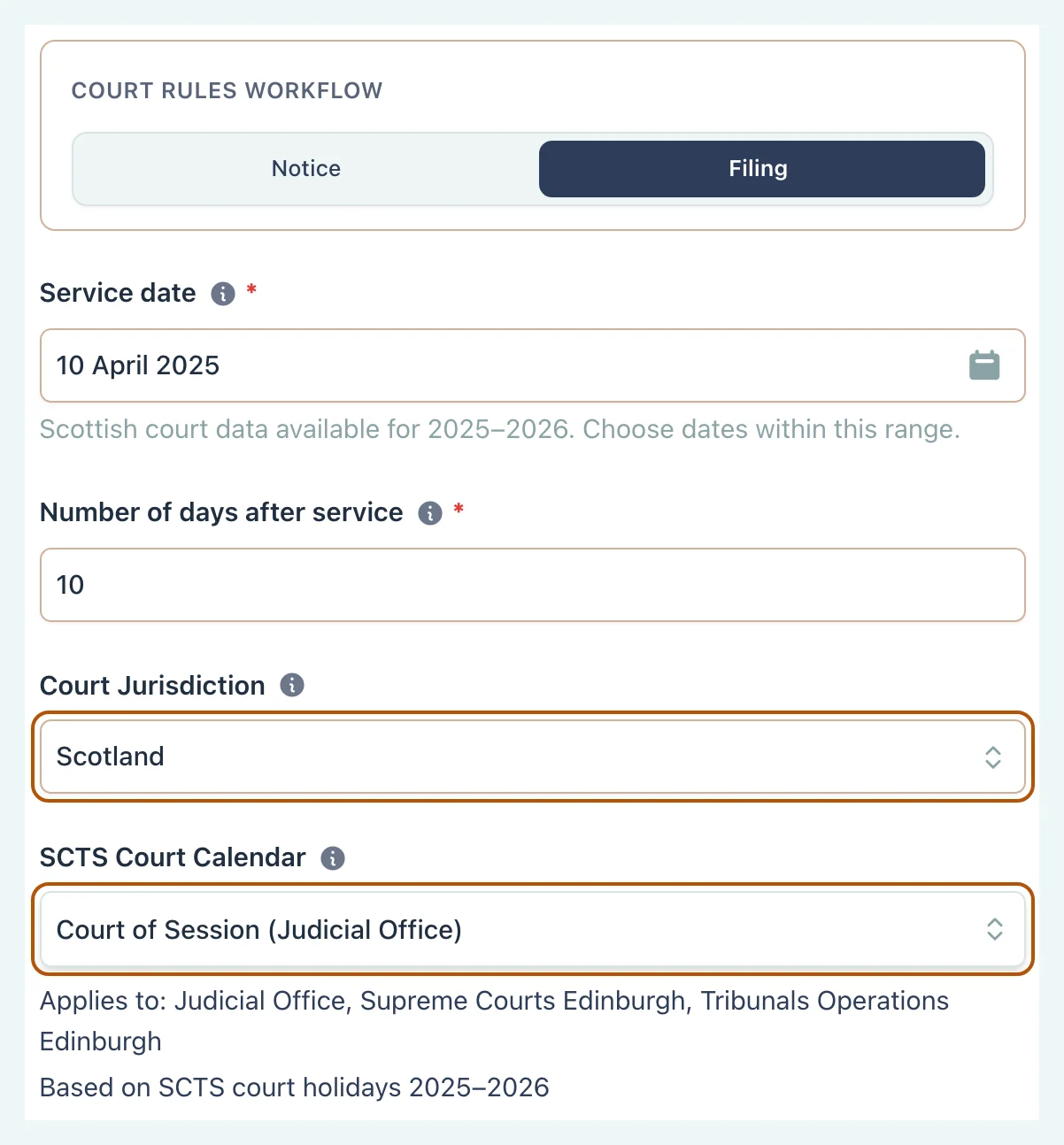
The Working Day Calculator's Court Rules Mode automatically applies 2026 SCTS closure dates. To use it:

  1. Enable Court Rules Mode in the calculator
  2. Select Scotland as your jurisdiction
  3. Choose your specific court from the SCTS locations dropdown
  4. Enter your dates and the calculator handles all closure exclusions

The results show excluded closure dates, automatic deadline rollover if applicable, and a full audit trail for your case file.

Read the Full Guide

For comprehensive information about 2026 SCTS holidays, closure dates for all 46 court locations, practical deadline calculation examples, and tips for legal professionals:

Frequently Asked Questions

Privilege days are court-specific closure dates announced annually by the Scottish Courts & Tribunals Service. Unlike bank holidays, which apply across the UK, privilege days vary by location. Each of the 46 Scottish court locations has a unique closure schedule that must be excluded when calculating working day deadlines.

No. Whilst all courts observe national closures (New Year, Easter, Christmas), each location has additional privilege days for local reasons such as staff training or building maintenance. You must use the schedule for your specific court—using a generic Scottish holiday list may result in miscalculated deadlines.

Identify your exact court location (e.g., 'Edinburgh Sheriff Court', 'Supreme Courts Glasgow', or your local Sheriff Court). The SCTS publishes annual holiday calendars for all 46 locations. Use the Working Day Calculator's Court Rules Mode and select your specific court from the dropdown to apply the correct 2026 closure dates automatically.

If a privilege day falls on Saturday or Sunday, the court typically operates normally that week—the closure does not carry forward to the next Monday. However, always check the official SCTS calendar for your court to confirm, as some closures may have substitute dates.

Half-day closures (marked with * in the SCTS calendar) are dates when courts close early, typically at noon or 2pm. For working-day calculation purposes, treat half-day closures as full closure days. If your deadline falls on a half-day closure date, factor in deemed service rules and plan accordingly.

Civil Procedure Rules

Court Rules Mode & Date Counting Guidance

Last reviewed: January 2026

At-a-Glance

  • Court Rules Mode locks notice and filing workflows to the correct rules for England & Wales (CPR), Scotland (SCTS), and Northern Ireland
  • Clear-day handling is automatic: notices exclude both endpoints (Scotland still includes the final day under civilis computatio) and filings exclude the service day but include the filing day
  • Short-notice thresholds – ≤5 days (England & Wales), ≤7 days (NI High Court), and ≤3 days (NI County Court) use working days; longer runs switch to calendar days
  • Scottish calculations merge your selected SCTS court calendar with bank holidays, including half-day closures
  • Filing deadlines roll forward to the next open court day when they land on weekends or bank holidays (e.g., Christmas Day, Boxing Day, New Year's Day)
UK court building

England & Wales (Civil Procedure Rules)

The Civil Procedure Rules (CPR) Part 2 set out how to calculate time limits for civil proceedings in England & Wales. Court Rules Mode reproduces CPR 2.8 definitions so you can rely on the calculator for acknowledgement, defence, and application windows without manual adjustments.

  • Working day (CPR 2.8(4)): Any day except Saturday, Sunday, a bank holiday, Christmas Day (25 Dec), Boxing Day (26 Dec), or Good Friday. Note: Weekdays between Christmas and New Year (27–31 Dec) are working days unless they fall on a weekend or are bank holidays (e.g., if 27 Dec is a substitute bank holiday for Boxing Day falling on a weekend).
  • Clear days (CPR 2.8(2)): Excludes both the start and end days. Court Rules Mode disables the include toggles so the correct behaviour is guaranteed.
  • Short notice thresholds: ≤5 days count working days; longer periods switch to calendar days automatically.

Scotland (SCTS Court Calendars)

Scottish proceedings follow the Scottish Courts and Tribunals Service guidance. Court Rules Mode combines your selected SCTS court calendar with bank holidays, respects half-day closures, and uses calendar-day counting for notices (civilis computatio).

  • Calendar days for notice: All notice periods count calendar days with the final day included.
  • Court calendars: Select the relevant sheriff court or the Court of Session so privilege holidays and half days are considered.
  • Bank holidays: The SCTS schedule is applied automatically, including Christmas Day, Boxing Day, 2 January, and any half-day finishes.

Northern Ireland

Northern Ireland follows its own Rules of Court. Court Rules Mode mirrors the published guidance, including the short-notice threshold and holiday treatment.

  • Notice thresholds: High Court matters use a 7-day threshold (≤7 days count working days). County Court matters use a 3-day threshold (≤3 days count working days). Choose the court level in the calculator to apply the correct rules automatically.
  • Clear days: Notices exclude both endpoints; filings include the filing day. Bank holidays and weekends are removed automatically.

Practical Example: 7 Clear Days' Notice (England & Wales)

You need to serve an application with 7 clear days' notice. You serve it on Monday 8 January 2025.

  • Exclude the service date (Monday 8 Jan)
  • Day 1: Tuesday 9 Jan
  • Day 7: Monday 15 Jan
  • Exclude the final day (Monday 15 Jan)
  • Earliest hearing date: Tuesday 16 January 2025

In the calculator, enter start date 8 Jan and add 7 days. Court Rules Mode automatically applies the correct clear-day rules and confirms which rule was applied, highlighting any adjustments.

Calculator Tips

  • Enable Court Rules Mode: This locks direction, counting method, and holiday handling for your chosen jurisdiction.
  • Select Notice or Filing: Each workflow enforces the correct thresholds, clear-day rules, and adjusts the direction automatically.
  • Choose a Scottish court calendar: When Scotland is selected, pick the relevant SCTS calendar so the right privilege holidays and half days are applied.
  • Review the summary: The results panel explains which rule was applied and highlights any extensions to the next court open day.

Frequently Asked Questions

Clear days means you exclude both the day the period starts and the day it ends. Court Rules Mode handles this automatically: the include/exclude date toggles are completely locked (disabled and hidden) so the correct clear-day rules are guaranteed. For notices, both the service and event dates are excluded (Scotland still includes the final day under civilis computatio). For filings, the service day is excluded but the filing day is included.

Court Rules Mode selects the correct method for you. Short notice periods are counted in working days (≤5 for England & Wales, ≤7 for Northern Ireland High Court, ≤3 for Northern Ireland County Court) while longer periods switch to calendar days. Scotland always counts notice periods in calendar days. For bespoke deadlines, check the relevant procedural guidance.

England & Wales applies CPR 2.8 bank holidays (Christmas Day, Boxing Day, New Year's Day, Good Friday, and other statutory bank holidays). Scotland blends bank holidays with the SCTS calendar you select, including half-day closures. Northern Ireland follows its court holiday calendar. When a working-day rule is in play, the calculator automatically excludes these non-working days.

Court Rules Mode automatically excludes bank holidays—including Christmas Day (25 Dec), Boxing Day (26 Dec), and New Year's Day (1 Jan)—from working day calculations (CPR 2.8). For Scotland, the calculator applies the SCTS schedule which includes 2 January and other Scottish-specific holidays. Note: UK courts do not have a 'Christmas shutdown period'; they are simply closed on specific bank holidays.

No. Pick Scotland as the jurisdiction, enable Court Rules Mode, and choose the relevant SCTS court calendar. The calculator merges privilege holidays, half days, and bank holidays to deliver the correct result.

Property Law

Conveyancing & Property Transactions

Last reviewed: January 2026

At-a-Glance

  • Sequential deadline mode chains up to 6 periods for complex transactions
  • Notice to Complete typically allows 10 working days from service
  • Exchange to completion periods are counted in working days
  • Bank holidays and regional variations affect conveyancing timelines
  • Boundary dates are handled automatically when periods connect
Property conveyancing documents and house keys

Managing Conveyancing Deadlines

Property transactions involve multiple sequential deadlines that must be tracked carefully. Missing a completion deadline or Notice to Complete can have serious financial consequences. The Working Day Calculator helps solicitors, conveyancers, and property buyers/sellers stay on track.

Sequential Periods for Property Transactions

Conveyancing rarely involves a single deadline. Instead, you're managing a chain of connected dates:

  • Finance approval → Mortgage offer received, start exchange countdown
  • Exchange of contracts → Binding agreement, completion date set
  • Completion → Funds transfer, keys handed over
  • Notice to Complete → Final 10 working days if delays occur

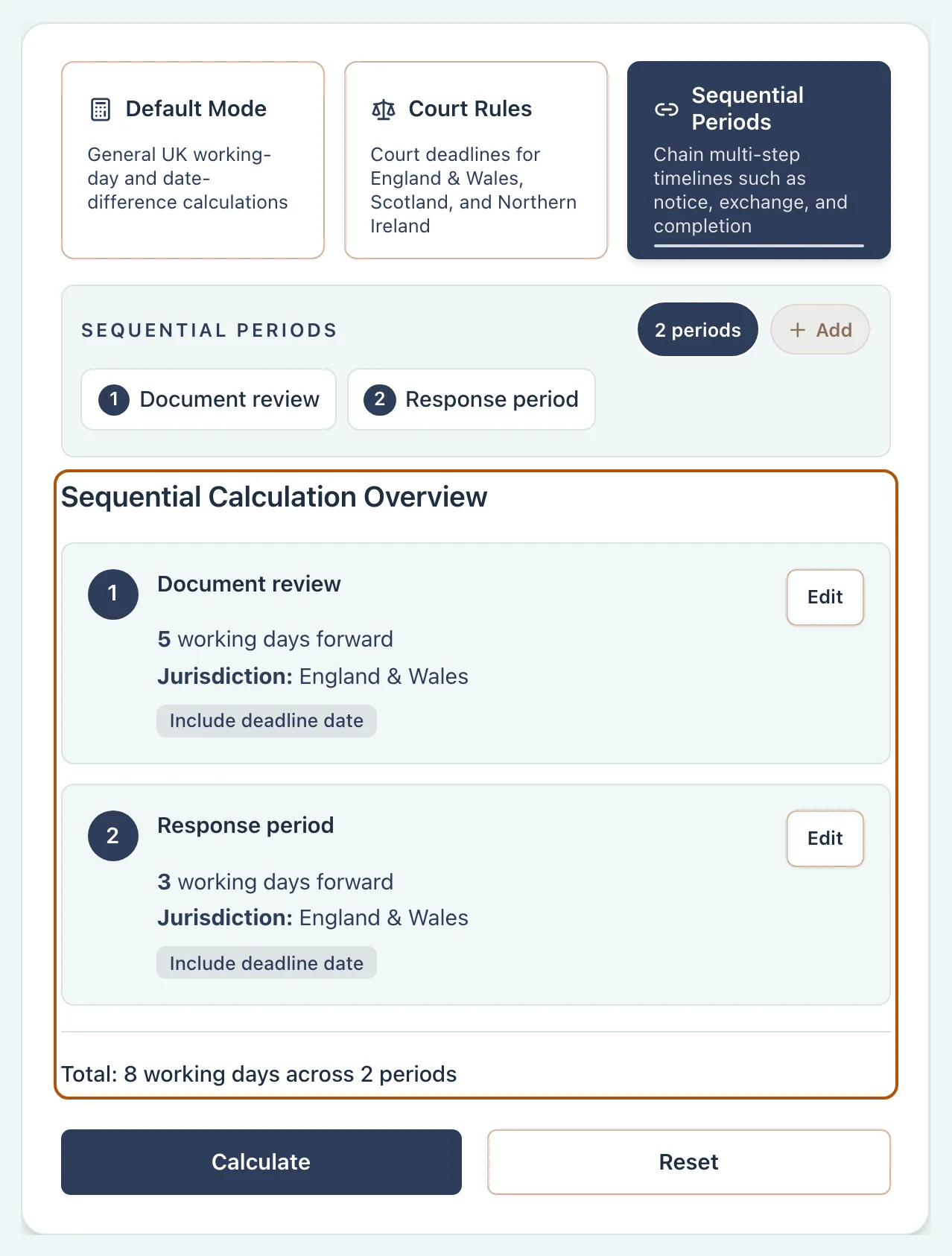
The calculator's Sequential Periods mode lets you chain these deadlines together. Each period's end date becomes the next period's start date, and the calculator handles boundary dates automatically.

Notice to Complete

A Notice to Complete is a formal notice that can be served by either party (provided they are ready, able and willing to complete) requiring completion within a specified timeframe—typically 10 working days. This is a crucial deadline:

  • Either party can serve a Notice to Complete if the other has failed to complete and they themselves are ready, able and willing
  • If the receiving party fails to complete within the notice period, the serving party may rescind the contract
  • Working days exclude weekends and bank holidays
  • Jurisdictional bank holiday differences (Scotland, Northern Ireland) can affect the deadline
  • The date of service is usually excluded from the count

Use the calculator to determine the exact completion deadline when a Notice to Complete is served.

Regional Considerations

Bank holidays vary across the UK, which can impact conveyancing timelines:

  • Scotland: Different bank holidays including St Andrew's Day (30 Nov) and 2 January
  • Northern Ireland: Additional holidays including St Patrick's Day (17 Mar) and Battle of the Boyne (12 Jul)
  • England & Wales: 8 bank holidays including Easter Monday and August bank holiday

Select the correct jurisdiction in the calculator to ensure accurate working day counts for your transaction.

Practical Example: Exchange to Completion

You exchange contracts on Friday 2 May 2025, with completion set for 14 working days later:

  1. Start date: Friday 2 May 2025 (exchange)
  2. Count 14 working days (excluding weekends and the Early May bank holiday on 5 May)
  3. Completion date: Friday 23 May 2025

The calculator shows you every excluded day and provides an audit trail for your file.

Getting Started

Plan Your Conveyancing Timeline →

Frequently Asked Questions

In UK conveyancing, a seller typically gives 10 working days' notice to complete:
  1. Enable Sequential Periods mode in the calculator
  2. Add Period 1: Set "Date of notice" as start date, add 10 working days
  3. The result shows your "Completion date" deadline

Tip: Use multiple periods to chain finance approval → exchange → completion → notice to complete dates. Try Sequential Mode →

Common conveyancing working day periods include:
  • Mortgage offer validity: Typically 3-6 months from offer date
  • Exchange to completion: Often 7-28 working days (negotiable)
  • Notice to Complete: 10 working days from service
  • Searches validity: Usually 6 months from date of issue

Always check your contract terms as these can vary. The calculator helps you track each deadline accurately.

Commercial Use

Business & Project Planning

Last reviewed: January 2026

At-a-Glance

  • Working days typically exclude weekends (Saturday & Sunday) and bank holidays
  • Different UK regions have different bank holiday calendars
  • Calendar day mode available for projects that work through weekends
  • Sequential mode supports multi-phase project planning
  • Export deadline calculations as PDFs for project documentation
Business planning and project timeline management

Accurate Timeline Planning for UK Businesses

Project managers, business analysts, and operations teams need accurate working day calculations for realistic timeline planning. The Working Day Calculator helps you account for weekends, bank holidays, and regional variations across the UK.

Common Business Scenarios

  • Project milestones: Calculate delivery dates for multi-phase projects
  • SLA tracking: Monitor service level agreements based on working days
  • Contract deadlines: Track notice periods and renewal dates
  • Procurement timelines: Plan tender submission and evaluation periods
  • Resource planning: Calculate available working days for capacity planning

Working Days vs Calendar Days

Understanding the difference is crucial for accurate planning:

  • Working days: Monday-Friday, excluding bank holidays. Standard for most UK business operations
  • Calendar days: All days including weekends and holidays. Used in some retail, hospitality, and manufacturing contexts

The calculator defaults to working days but you can toggle to calendar days if your business operates seven days a week.

Example: SLA deadline planning

If a contract gives you 15 working days to deliver after kickoff, use deadline mode, select the correct jurisdiction, and count 15 working days forward. The calculator will skip weekends and bank holidays, then show the precise due date plus the excluded days for your audit trail.

For multi-region projects, run the calculation once per jurisdiction and plan to the most conservative deadline.

Regional Working Day Variations

If your business operates across multiple UK regions, be aware that working day counts differ:

  • England & Wales typically has 252-253 working days per year
  • Scotland and Northern Ireland have slightly different counts due to additional bank holidays
  • One-off royal events (jubilees, coronations) create additional bank holidays

For multi-jurisdiction projects, consider using the jurisdiction with the fewest working days for conservative timeline estimates.

Multi-Phase Project Planning

Complex projects often have sequential phases with interdependent deadlines. Use Sequential Periods mode to:

  • Chain up to 6 project phases with automatic date linking
  • See exactly when each phase starts and ends
  • Account for bank holidays across the entire project timeline
  • Export the full timeline as a PDF for stakeholder reporting

Year-Round Planning

For annual planning and capacity forecasting, check the Year Summary page which provides:

  • Total working days by jurisdiction for the current and upcoming years
  • Month-by-month working day breakdowns
  • Visual calendar showing all bank holidays and weekends

Getting Started

Calculate Project Timelines →

Frequently Asked Questions

It varies by month and jurisdiction due to bank holidays. Most months have 20-23 working days (Monday-Friday, excluding bank holidays). To find working days for a specific month:
  • Use the calculator to count between the 1st and last day of the month
  • Check the Year Summary page for month-by-month breakdowns
  • Select your jurisdiction (England & Wales, Scotland, or Northern Ireland) for accurate counts
No. Scotland and Northern Ireland have unique bank holidays:
  • England & Wales: Includes Easter Monday, Early May Bank Holiday, Spring Bank Holiday, Summer Bank Holiday, Christmas
  • Scotland: Also celebrates 2 January and St Andrew's Day (30 Nov); Easter Monday is NOT a bank holiday in Scotland
  • Northern Ireland: Also celebrates St Patrick's Day (17 Mar) and Battle of the Boyne (12 Jul)

Select your jurisdiction in the calculator to ensure accurate holiday exclusion. Learn more about jurisdictional differences →

Employment Law

HR, Holidays & Leave Planning

Last reviewed: January 2026

At-a-Glance

  • UK workers entitled to minimum 5.6 weeks (28 days) paid annual leave
  • Bank holidays may or may not be included in statutory entitlement
  • Different jurisdictions have different numbers of bank holidays (8-10 per year)
  • Notice periods for annual leave often calculated in working days
  • Year Summary page shows working days by month for capacity planning
HR planning and holiday management

HR Tools for UK Holiday Management

Human Resources teams need accurate working day calculations for leave management, notice period tracking, and workforce planning. The Working Day Calculator helps HR professionals handle the complexities of UK statutory leave entitlements and jurisdictional bank holiday variations.

UK Statutory Leave Entitlement

All UK workers are entitled to 5.6 weeks of paid annual leave per year under the Working Time Regulations. For full-time employees working 5 days per week, this equals 28 days. However, the statutory entitlement is capped at 28 days by law—even employees working 6 or 7 days a week are only guaranteed a minimum of 28 days' paid holiday. Key points:

  • The 28-day cap is the statutory minimum—employers can offer more, but are not legally required to exceed this limit
  • Bank holidays may or may not be included, depending on the employment contract (see below)
  • Part-time workers get the same 5.6 weeks entitlement pro-rated to their working pattern
  • For irregular hours or part-year workers, leave accrues at 12.07% of hours worked (post-2024 guidance)
  • Leave accrues from the first day of employment

Bank Holidays and Leave Entitlement

There is no automatic legal right to time off on bank holidays. Under UK employment law, bank holidays are treated just like any other day—time off, extra pay, or any special treatment on bank holidays is entirely at the employer's discretion and must be specified in the employment contract. Employers can require staff to work on bank holidays and are not required to pay a premium unless contractually agreed.

Whether bank holidays count toward the statutory 28-day minimum or come in addition depends entirely on the contract wording:

  • Inclusive contracts: "28 days including bank holidays" = 20 days discretionary leave + 8 bank holidays (meets the statutory minimum)
  • Exclusive contracts: "28 days plus bank holidays" = 28 days discretionary leave + 8 bank holidays (36 total days—exceeds statutory minimum)

HR teams must clearly specify in contracts whether bank holidays are included in or additional to the statutory 28-day entitlement. Any bank holiday benefit is a contractual choice, not a legal obligation, as long as the total leave meets the 28-day statutory minimum.

Jurisdictional Considerations for Multi-Site Employers

If your organisation operates across multiple UK jurisdictions, be aware of the different number of public holidays observed in each jurisdiction. Note that these are the number of bank/public holidays designated in each jurisdiction, not automatic employee entitlements—whether employees get these days off depends on their contract:

  • England & Wales: 8 bank holidays per year
  • Scotland: 9 bank holidays (includes 2 January and St Andrew's Day; no Easter Monday)
  • Northern Ireland: 10 bank holidays (includes St Patrick's Day and Battle of the Boyne)

All UK workers still have the same statutory minimum of 5.6 weeks/28 days' leave regardless of jurisdiction. For example, a Northern Ireland employee's 10 public holidays might be counted as part of their 28 days if the contract specifies "28 days including bank holidays."

To avoid complexity and ensure fairness, some employers standardise leave policies across jurisdictions by giving all UK staff the same number of bank holiday days off (e.g., 10 days to match Northern Ireland). This is a company policy choice, not a legal requirement, but helps equalize time off across regions.

Notice Periods for Annual Leave

The UK Working Time Regulations establish statutory minimum notice requirements for annual leave. Unless an employer's policy or contract specifies otherwise (and meets or exceeds these minima), the default legal rules are:

  • Employee notice: Employees must give at least twice the length of the requested leave as advance notice (e.g., 10 working days' notice for 5 days' leave)
  • Employer refusal/cancellation: Employers must give notice at least equal to the length of the leave period to refuse or cancel a holiday request
  • These are legal minimums, not just common practices—employers can set longer notice periods, but not shorter, in their policies

Use the calculator to determine statutory notice deadlines and ensure compliance with the Working Time Regulations.

Example: Leave notice calculation

If your policy requires 10 working days' notice for a 5-day leave request, count back 10 working days from the first day of leave. The calculator will skip weekends and any bank holidays in the relevant jurisdiction so you can set the latest notice date accurately.

If your policy uses calendar days instead, switch to calendar-day mode to avoid missing the statutory minimum.

Working Day Calculations for HR

Common HR scenarios requiring working day calculations:

  • Notice periods: Calculate last working day for resignations and terminations
  • Leave year planning: Calculate annual working days for capacity planning
  • TUPE transfers: Calculate consultation periods and transfer dates
  • Grievance and disciplinary timelines: Track statutory timelines for employment procedures

Capacity Planning and Resource Management

For workforce planning, knowing the exact number of working days available is crucial. The Year Summary page provides:

  • Total working days per year by jurisdiction
  • Month-by-month breakdowns for capacity forecasting
  • Visual calendar highlighting bank holidays and weekends
  • Comparison across England, Scotland, and Northern Ireland

Getting Started

Calculate Leave Periods & Notice Dates →

Frequently Asked Questions

It varies by jurisdiction due to bank holidays:
  • England & Wales: Approximately 252-253 working days per year (8 bank holidays)
  • Scotland: Approximately 251-252 working days per year (9 bank holidays)
  • Northern Ireland: Approximately 250-251 working days per year (10 bank holidays)

See our Year Summary page for exact counts by jurisdiction and year, including month-by-month breakdowns.