Use Cases
UK Working Day Use Cases
Conveyancing Professional:
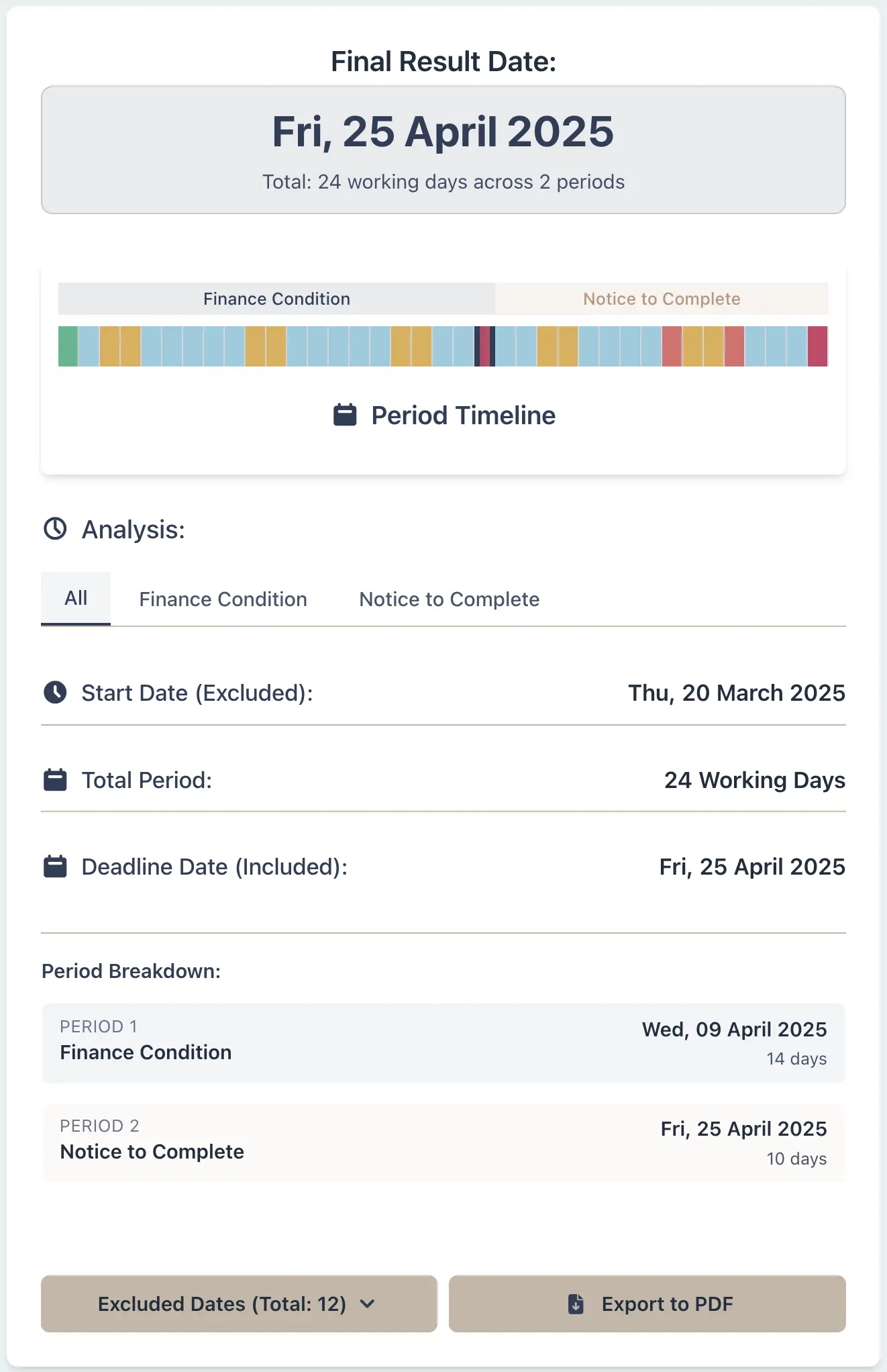
Model an SCS Notice to Complete Period
Scenario
Assume an England and Wales residential contract incorporates the Standard Conditions of Sale (5th edition, 2018 revision) without changing the relevant provisions, and a notice is established as given on 17 December 2026. Condition 6.8.2 provides for completion within ten working days, excluding the notice day. Before relying on the result, check the contract and transaction facts to confirm that the notice mechanism applies and when the notice was given.
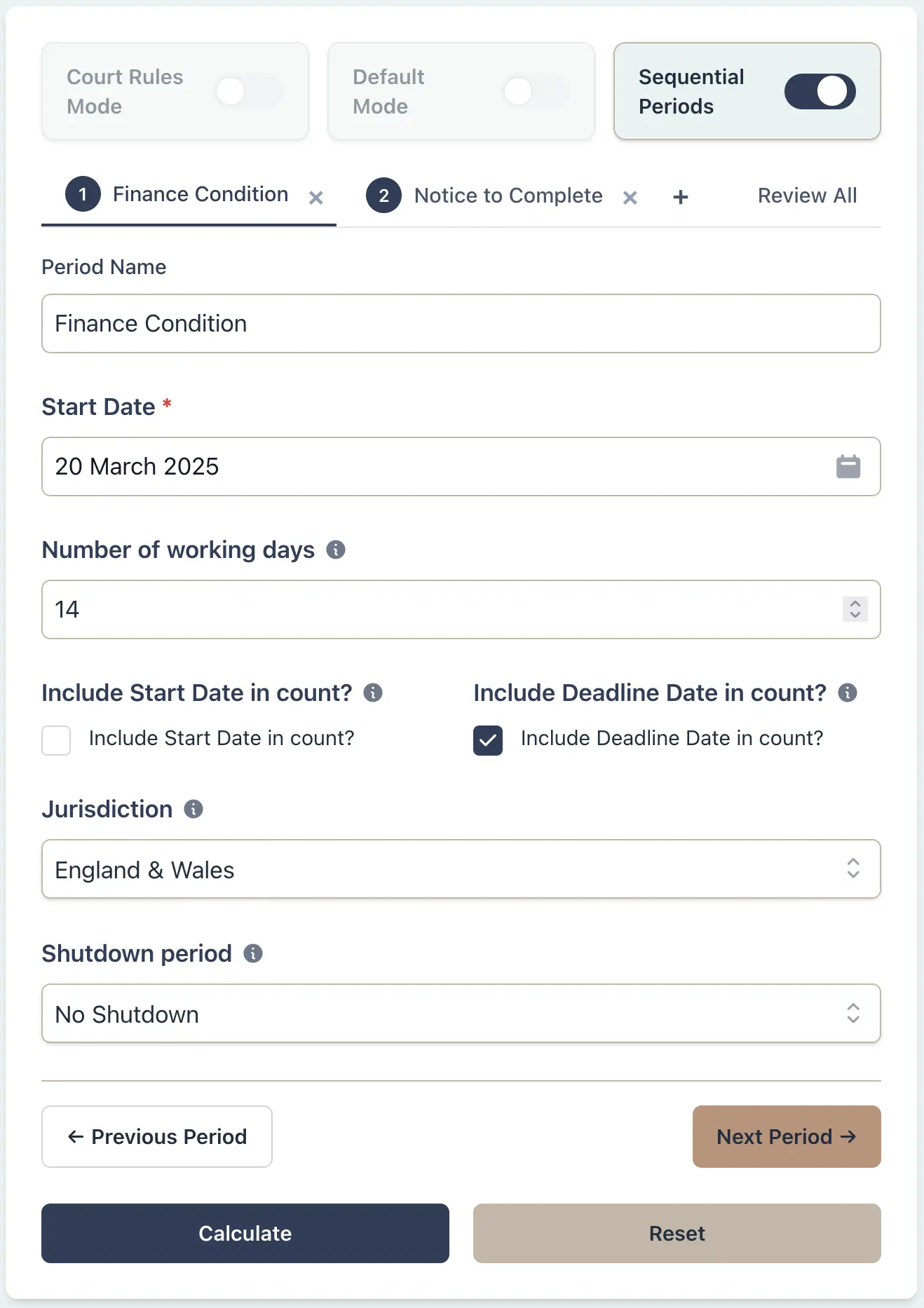
Example Workflow
Use the step row to inspect each part of the workflow.
9 stepsStep 1
Deadline
Select Deadline
Result Example
Why This Matters
- •Model a verified contractual period without treating it as a universal rule
- •Apply the England and Wales bank holidays
- •Show exactly which weekends and holidays were excluded
- •Save a reproducible record of the calculator inputs
- •Change the inputs when the signed contract varies the standard conditions
Litigation Solicitor:
CPR Notice – 3 Clear Days for an Interim Application
Scenario
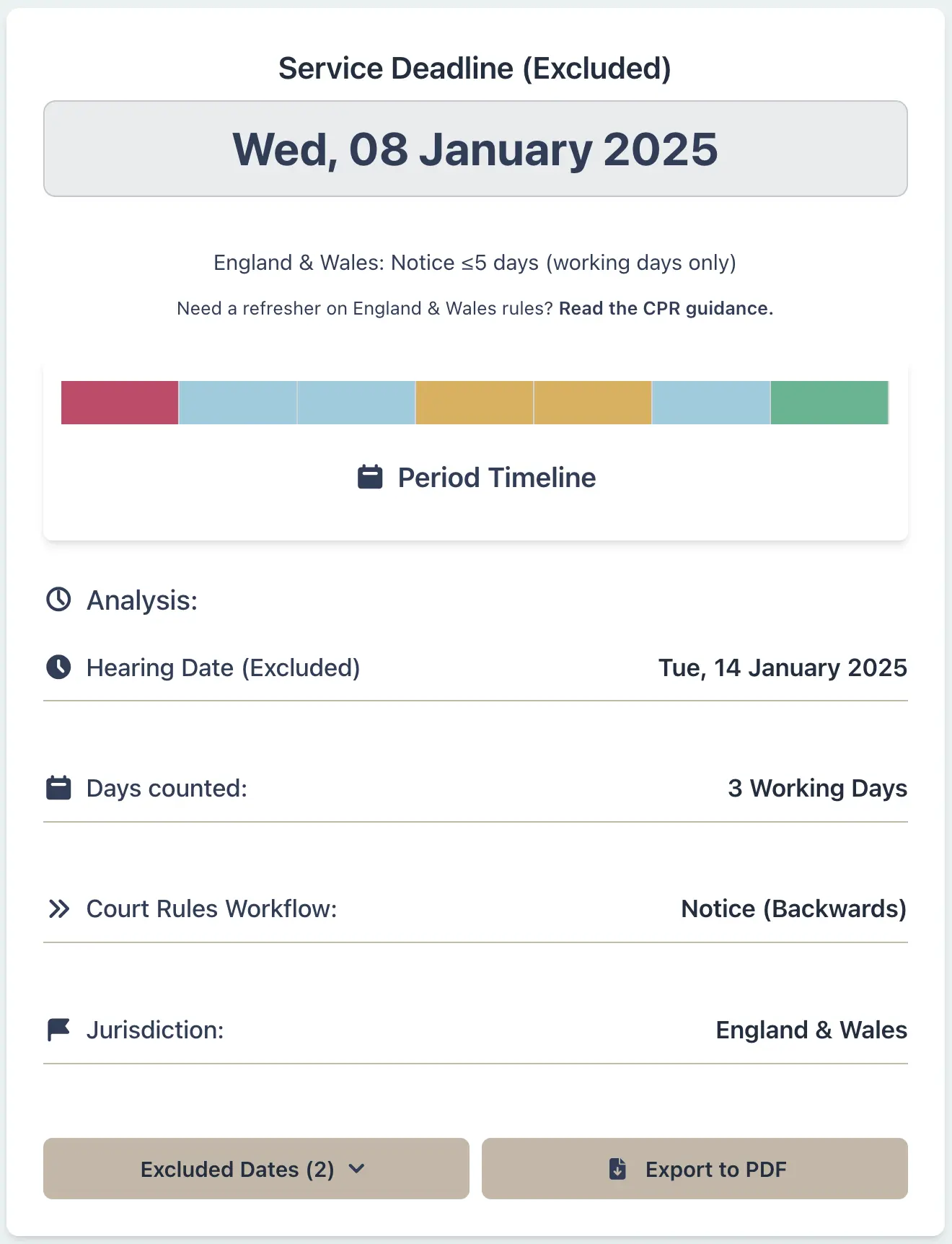
Assume an interim application hearing in the High Court of England and Wales is listed for Tuesday 13 January 2026 and CPR 23.7(1)(b)'s three-clear-day period applies. Court rules count backwards using the CPR boundary and short-period rules. The user must still confirm the hearing date, service method, and rule that applies.
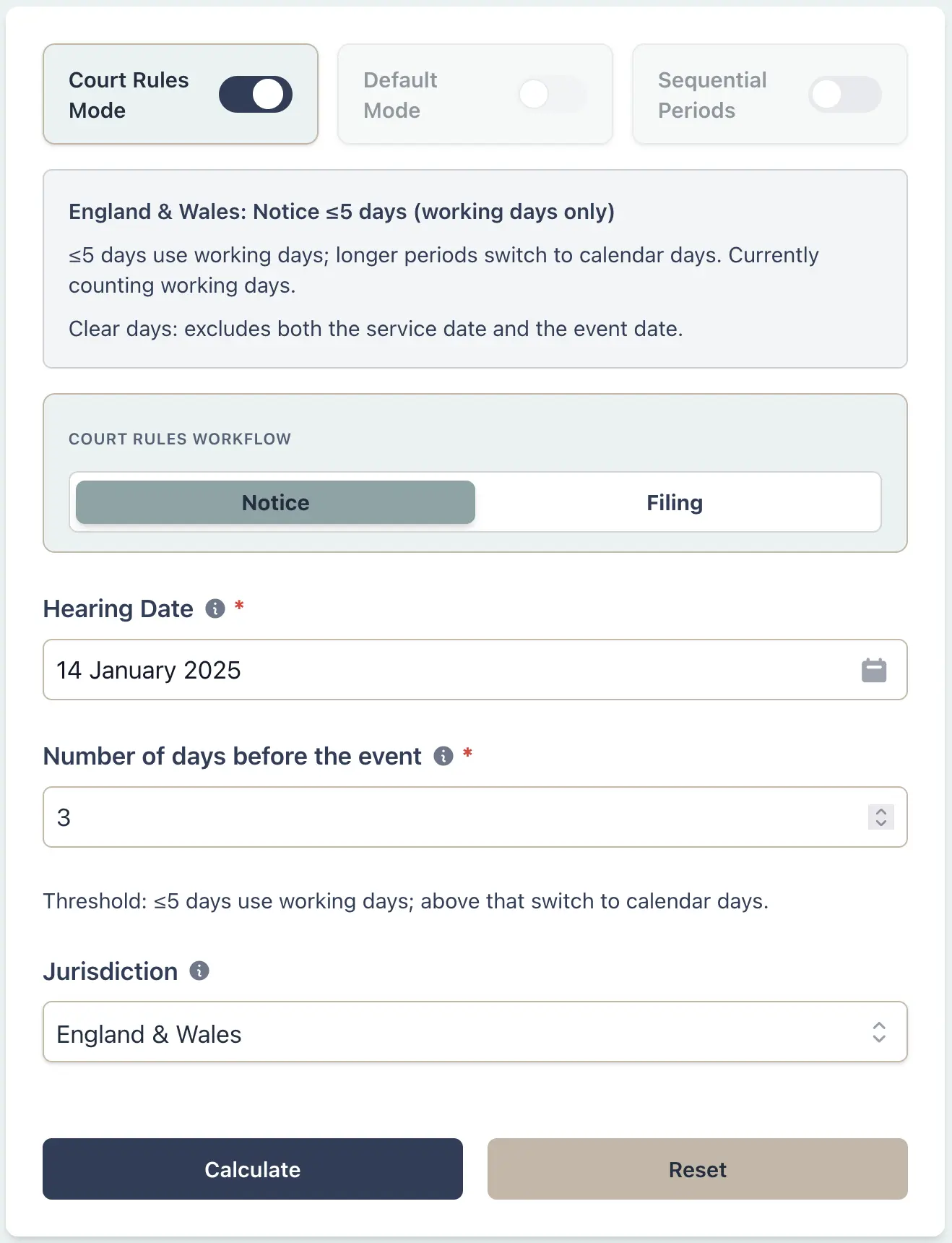
Example Workflow
Use the step row to inspect each part of the workflow.
8 stepsStep 1
Deadline
Select Deadline
Result Example
Why This Matters
- •Apply the 3 clear days requirement without hand counting
- •Avoid miscounting weekends or bank holidays when working to CPR Part 23
- •Show the calculated service date and the days left out
- •Keep the hearing date, court jurisdiction, and period visible for checking
Scottish Litigation:
SCTS Filing Deadline Across the Easter Court Closures
Scenario
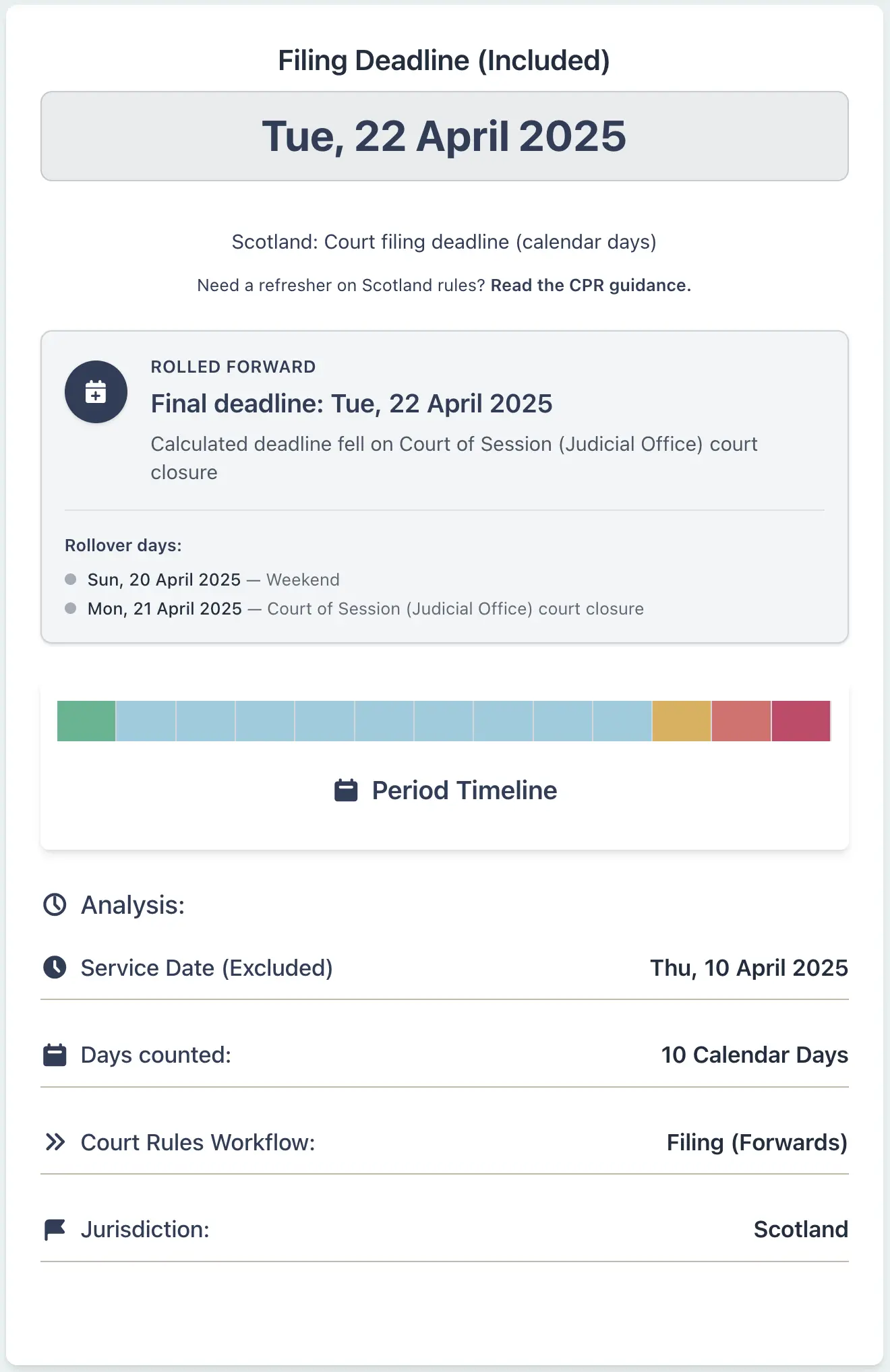
Assume a Court of Session timetable gives ten days from a start date of 26 March 2026. The Judicial Office closure dates and Scottish bank holidays cover the Easter period. Check the timetable or order for the correct start date and period before relying on the result.
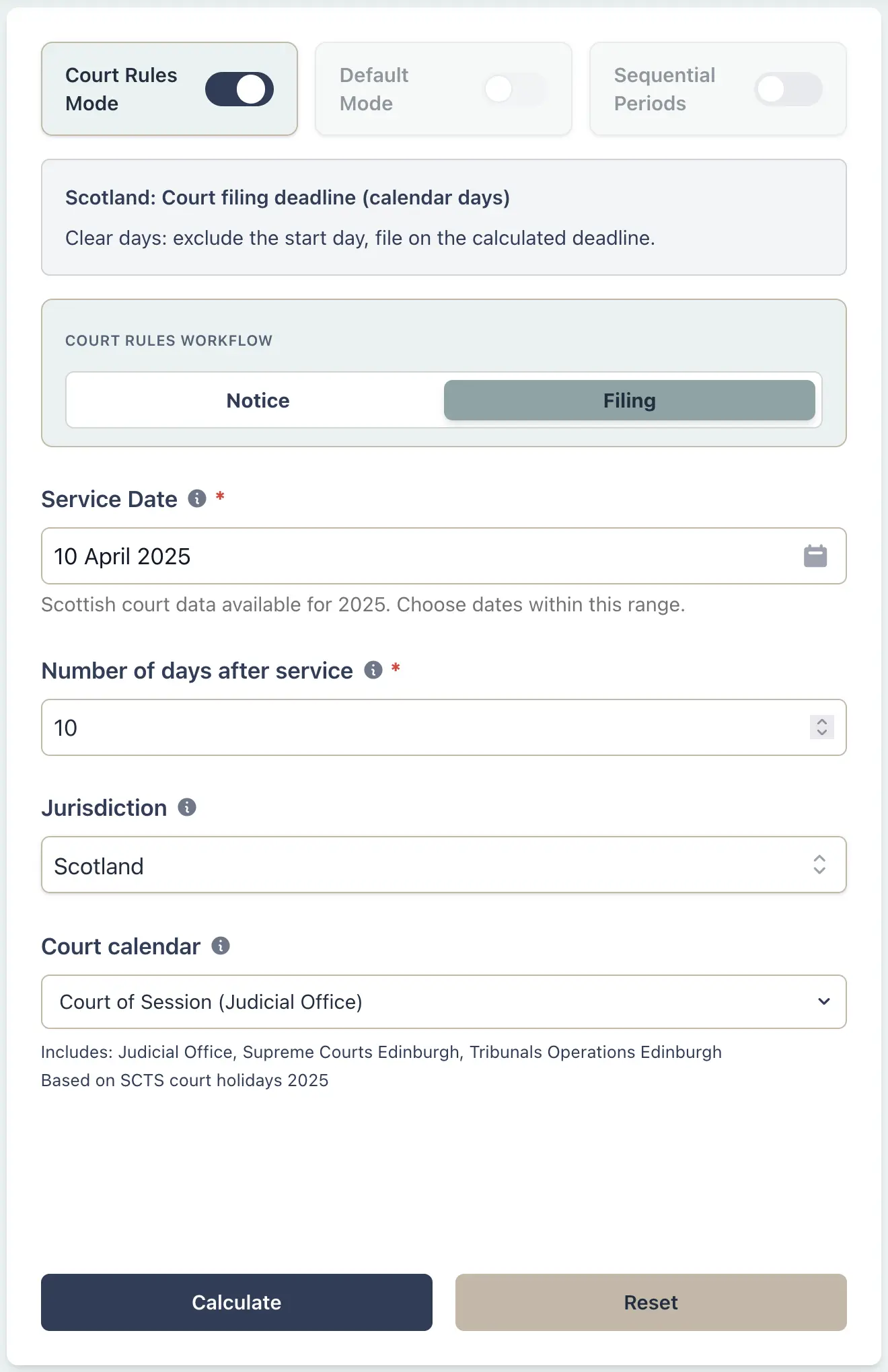
Example Workflow
Use the step row to inspect each part of the workflow.
9 stepsStep 1
Deadline
Select Deadline
Result Example
Why This Matters
- •Use both SCTS closure dates and Scottish bank holidays
- •See when filings roll forward to the next open court day
- •Show the selected SCTS court or office
- •List the closure dates used in the result
Northern Ireland Litigation:
High Court Notice – 5 Clear Days Over the Twelfth Fortnight
Scenario
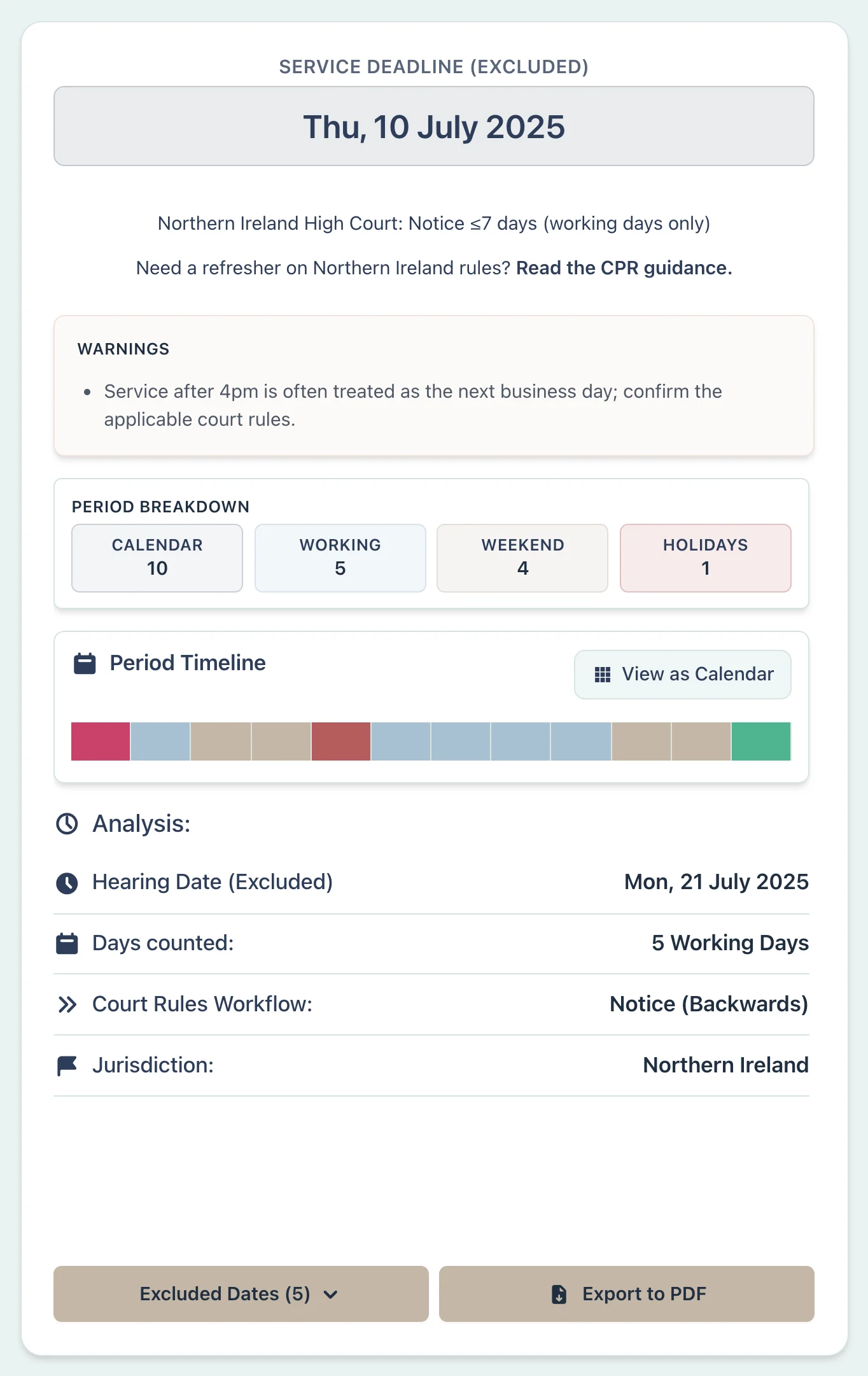
Assume a High Court of Northern Ireland hearing is listed for Monday 20 July 2026 and the relevant rule requires five clear days' notice. The Battle of the Boyne holiday falls on 13 July in Northern Ireland. Court rules count backward using the High Court short-period and clear-day settings.
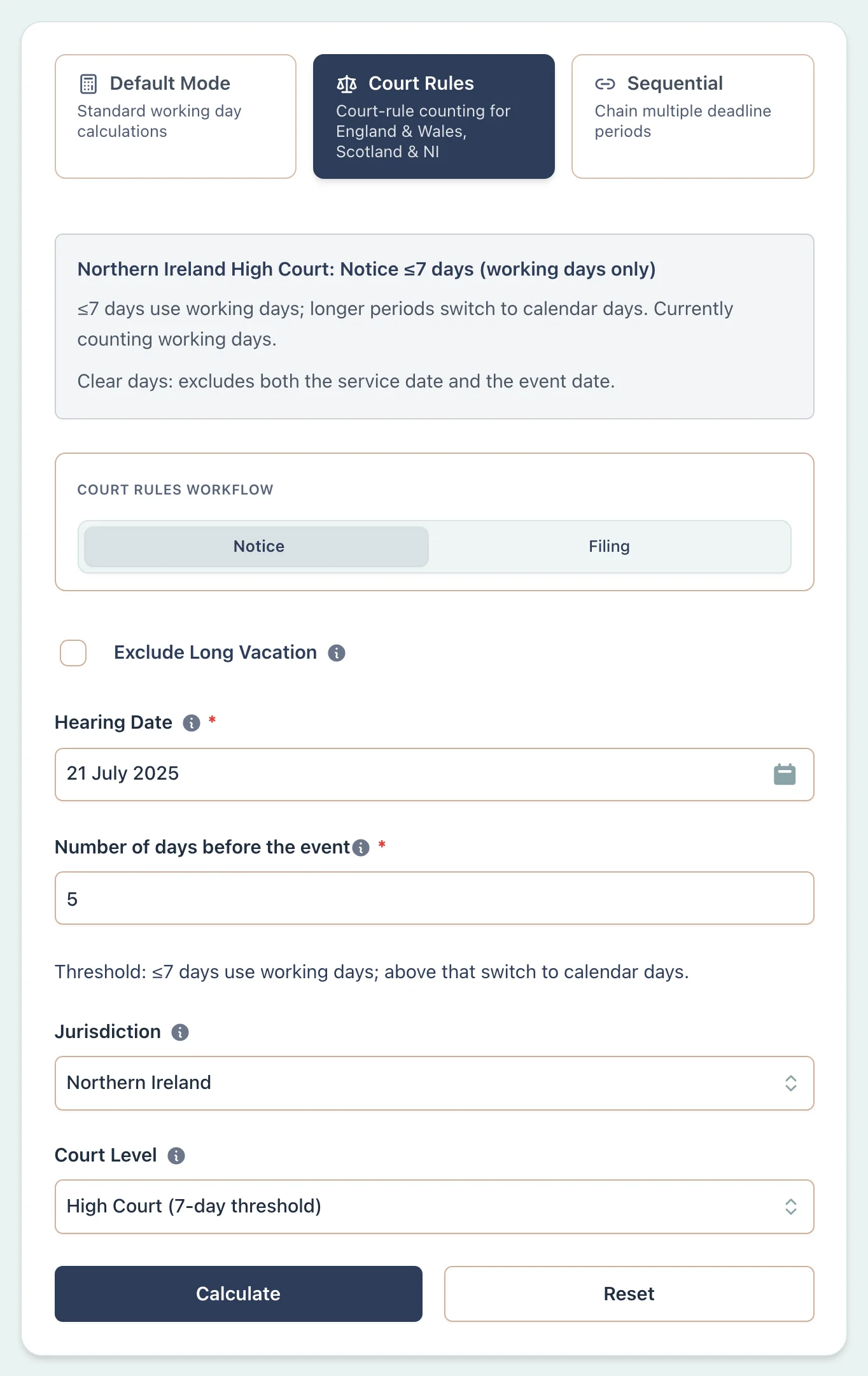
Example Workflow
Use the step row to inspect each part of the workflow.
9 stepsStep 1
Deadline
Select Deadline
Result Example
Why This Matters
- •Apply Northern Ireland's bank holidays, including the Twelfth
- •Apply the High Court threshold (≤7 days = working days, clear days)
- •Keep the Northern Ireland court level visible
- •List the dates left out of the count
HR Manager:
Six-Week Statutory Notice Example
Scenario
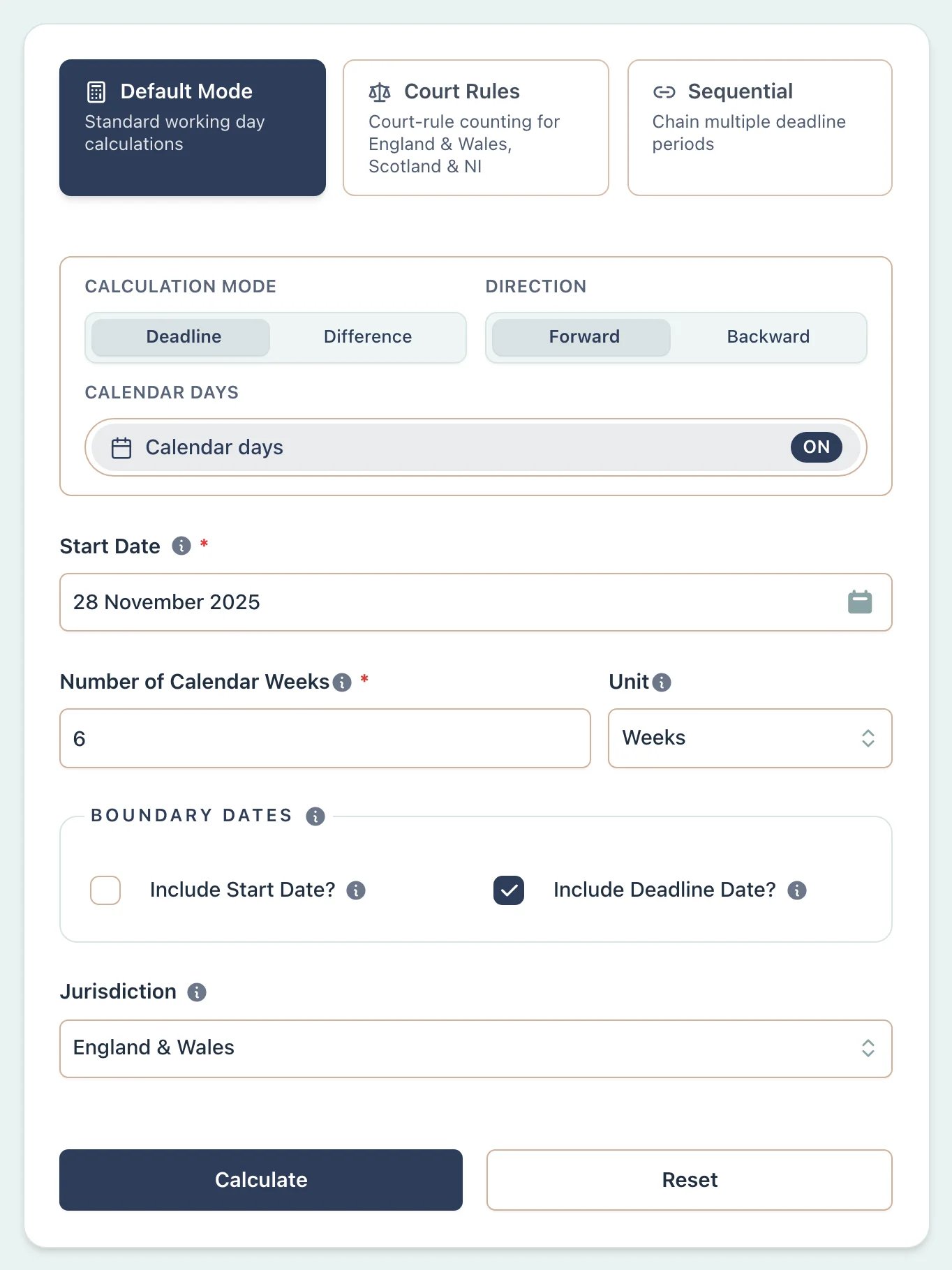
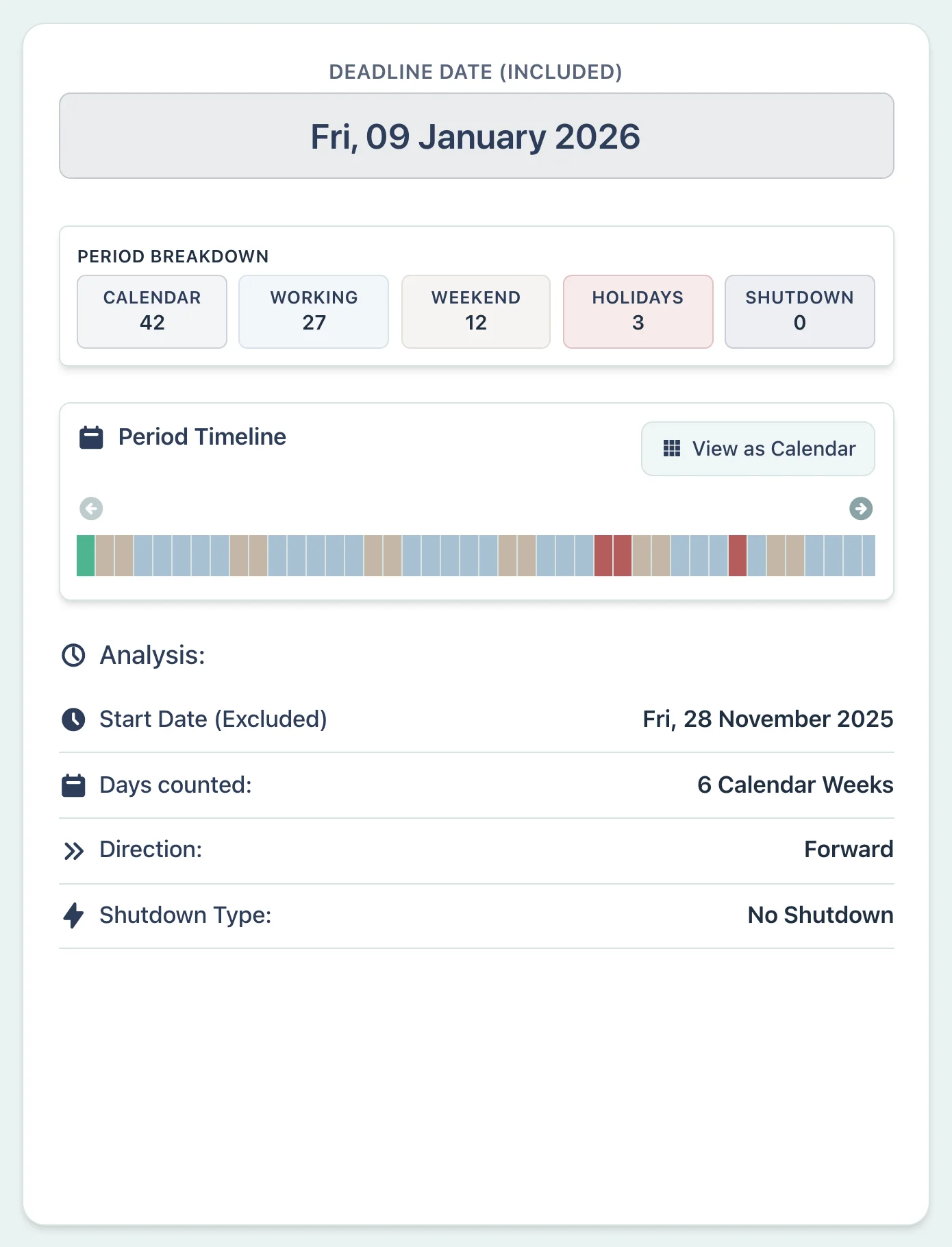
Assume an employee in England has six complete years of continuous service, the statutory minimum in section 86 of the Employment Rights Act 1996 applies, and notice takes effect after it is given on 27 November 2026. This example counts six calendar weeks. It does not decide whether a longer contractual period applies or whether notice was validly given.
Example Workflow
Use the step row to inspect each part of the workflow.
8 stepsStep 1
Deadline
Select Deadline
Result Example
Why This Matters
- •Counts a supplied six-week period in calendar weeks
- •Shows that weekends and bank holidays remain in the count
- •Keeps the assumed notice date and boundary settings visible
- •Leaves notice entitlement, effective service, pay, and dismissal questions for separate checking
Quantity Surveyor:
Five-Day Construction Payment Notice Period
Scenario
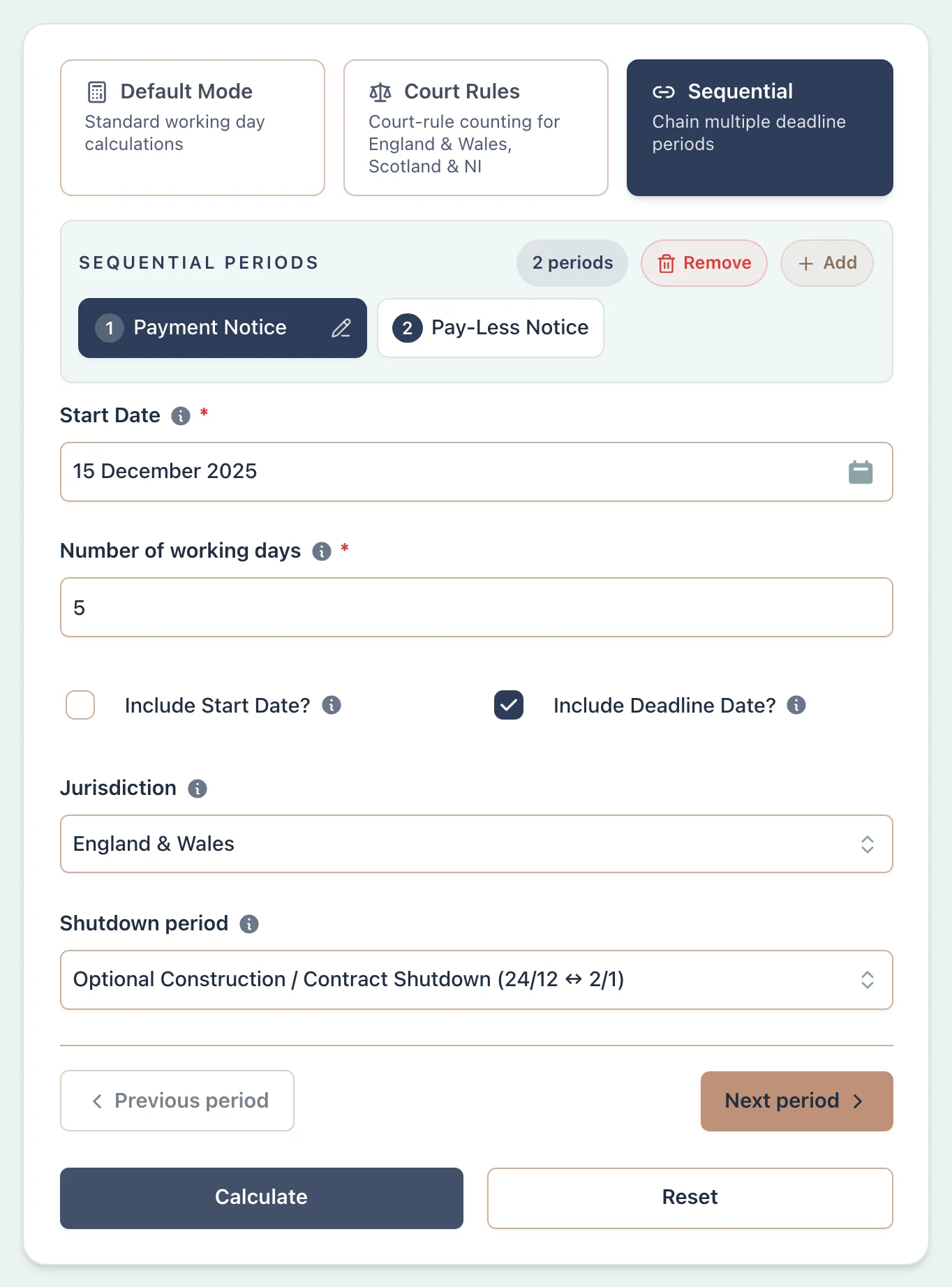
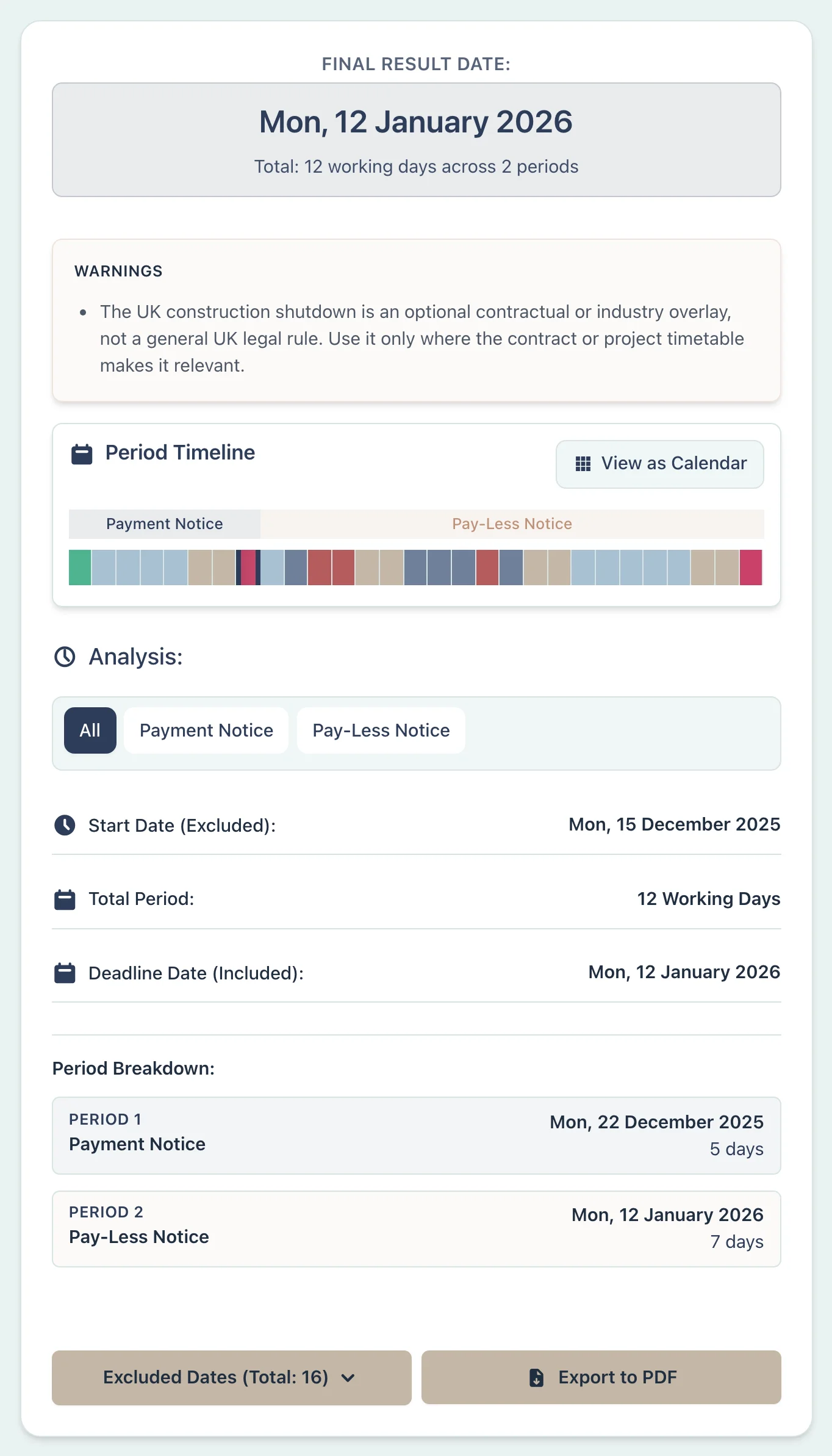
Assume 15 December 2026 is the payment due date under a construction contract and the five-day period in section 110A of the Housing Grants, Construction and Regeneration Act 1996 applies. The Act says the notice must be given no later than five days after the due date. It does not turn those five days into working days or add an industry Christmas shutdown. This example counts that period only.
Example Workflow
Use the step row to inspect each part of the workflow.
9 stepsStep 1
Deadline
Select Deadline
Result Example
Why This Matters
- •Shows the five-day payment-notice period as a calendar-day count
- •Keeps the due date and boundary choices visible
- •Does not add a Christmas shutdown that the Act does not provide
- •Leaves the contract, notice route, and service requirements for separate checking